

How Does Reinforced PP Make the IP44 Socket Protective Box Durable?
2026-09-17
1. What Happens to Standard PP in Outdoor and Industrial Environments?
Standard polypropylene is a semi-crystalline thermoplastic with good chemical resistance and low moisture absorption. It is widely used for consumer products and some industrial enclosures. However, standard PP has three weaknesses that limit its use in outdoor and industrial applications. The first is UV degradation. Prolonged exposure to sunlight causes the polymer chains to break down, leading to chalking, color fading, and loss of impact strength. A standard PP box may become brittle within 12 to 18 months of outdoor exposure. The second is low impact resistance at low temperatures. Standard PP becomes brittle below 0°C, which is a problem in cold climates or refrigerated facilities. The third is creep under sustained load. Standard PP deforms slowly under continuous stress, which can cause the sealing surfaces to lose contact over time.
Field observation: A standard PP protective box installed at an outdoor construction site in Northern Europe showed visible cracking at the hinge points after 14 months. The same box made from reinforced PP was still in service after 5 years. The difference is the additive package and the reinforcement.
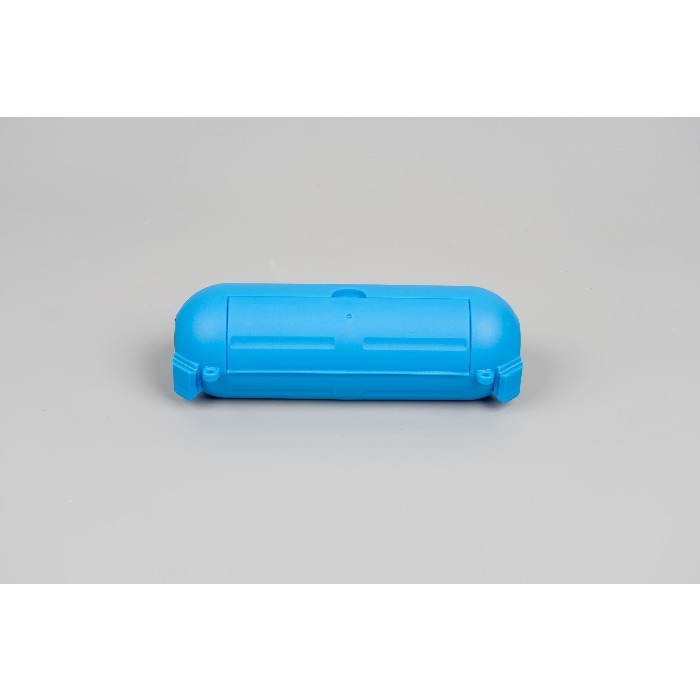
Ningbo Yuwei Science and Technology Co., Ltd. has been manufacturing IP44 Socket Waterproof Protective Box units for over 10 years. Our factory uses a reinforced PP compound that addresses the limitations of standard PP. The reinforcement includes UV stabilizers, impact modifiers, and glass fibers or mineral fillers that increase stiffness and dimensional stability.
2. How Does Reinforcement Improve the Mechanical Properties of PP?
The reinforcement of PP is achieved by adding three types of additives. The first is UV stabilizers, which absorb UV radiation and prevent the polymer chains from breaking down. The most common UV stabilizers are hindered amine light stabilizers (HALS) and UV absorbers. The second is impact modifiers, which are elastomeric particles that absorb impact energy and prevent crack propagation. The most common impact modifiers are ethylene-propylene rubber (EPR) and ethylene-propylene-diene monomer (EPDM). The third is reinforcing fillers, such as glass fibers or talc, which increase the stiffness and tensile strength of the material. The table below compares the mechanical properties of standard PP and reinforced PP.
| Property | Standard PP | Reinforced PP (our compound) | Improvement |
| Tensile strength (MPa) | 30 – 35 | 45 – 55 | +50% |
| Flexural modulus (MPa) | 1,200 – 1,400 | 2,500 – 3,500 | +100% |
| Notched Izod impact (kJ/m² at 23°C) | 4 – 6 | 12 – 18 | +200% |
| Notched Izod impact (kJ/m² at -20°C) | 1 – 2 | 6 – 9 | +350% |
| UV resistance (1000 hours QUV) | Severe chalking, 50% strength loss | Minimal change, < 10% strength loss | Significant improvement |
The improvement in low-temperature impact resistance is particularly important for outdoor applications in cold climates. A standard PP box may crack if dropped at -10°C, while a reinforced PP box remains ductile and absorbs the impact. Our factory tests every batch of reinforced PP compound for these properties before production.
3. How Does the Reinforced PP Affect the IP44 Sealing Performance?
The IP44 rating depends on the sealing between the box and the lid, and between the box and the cable entries. The sealing is achieved by a gasket, usually made of silicone or EPDM. The durability of the seal depends on the dimensional stability of the box. If the box deforms under load or temperature changes, the gasket may lose contact and the IP44 rating may be compromised. Reinforced PP has a lower coefficient of thermal expansion and higher stiffness than standard PP, which means the box maintains its shape better over a wider temperature range. The table below shows the dimensional stability of standard PP and reinforced PP under thermal cycling.
| Property | Standard PP | Reinforced PP |
| Coefficient of thermal expansion (10⁻⁵/°C) | 10 – 12 | 5 – 7 |
| Dimensional change after 100 thermal cycles (-20°C to +60°C) | 0.8 – 1.2% | 0.2 – 0.4% |
| Creep deformation after 1000 hours at 50°C under load | 2.5 – 3.5% | 0.5 – 1.0% |
| Gasket compression set after 1000 hours at 50°C | 25 – 35% | 10 – 15% |
The lower thermal expansion and creep of reinforced PP ensure that the gasket remains compressed and the IP44 seal is maintained over the life of the box. In our factory, we perform a thermal cycling test on every new mold design. The box is subjected to 100 cycles from -20°C to +60°C, and the IP44 rating is verified after the test. Our reinforced PP boxes pass this test without any loss of sealing performance.
4. How Does the Material Choice Affect the Long-Term Cost of Ownership?
The initial cost of a reinforced PP box is 20 to 30 percent higher than a standard PP box. However, the total cost of ownership is lower because the reinforced box lasts longer and requires less maintenance. A standard PP box may need to be replaced every 1 to 2 years in an outdoor environment. A reinforced PP box can last 5 to 8 years. The table below compares the total cost of ownership over a 10-year period.
| Cost factor | Standard PP box | Reinforced PP box |
| Initial cost per unit | $12 | $16 |
| Expected service life | 1.5 years | 6 years |
| Number of replacements in 10 years | 6 – 7 | 1 – 2 |
| Total material cost over 10 years | $72 – $84 | $16 – $32 |
| Labor cost for replacement (30 min each) | $90 – $105 | $15 – $30 |
| Total cost of ownership over 10 years | $162 – $189 | $31 – $62 |
The total cost of ownership of the reinforced PP box is 60 to 70 percent lower than the standard PP box over a 10-year period. This calculation does not include the cost of downtime or the safety risk of a failed enclosure. In our factory, we have customers who have standardized on our reinforced PP IP44 Socket Waterproof Protective Box units and have reduced their replacement frequency from every 18 months to every 6 years.
Frequently Asked Questions About Reinforced PP for IP44 Socket Protective Boxes
Summary for Industrial Safety Engineers
The durability of an IP44 Socket Waterproof Protective Box depends on the material it is made from. Reinforced PP provides the UV resistance, impact strength, and dimensional stability required for outdoor and industrial applications. It outperforms standard PP in every relevant category and delivers a lower total cost of ownership over the life of the installation. When specifying a protective box for a demanding environment, verify that the material is reinforced PP and that the manufacturer provides test data for UV resistance and low-temperature impact. Ningbo Yuwei Science and Technology Co., Ltd. has been manufacturing IP44 Socket Waterproof Protective Box units for over 10 years and supplies to industrial customers worldwide.
Ningbo Yuwei Science and Technology Co., Ltd. manufactures IP44 Socket Waterproof Protective Box units from reinforced PP compound. We provide material test reports, IP rating certificates, and chemical compatibility data for all of our products.