

Why Do Mechanics Prefer Rolling Tool Bags Over Backpacks
2026-10-28
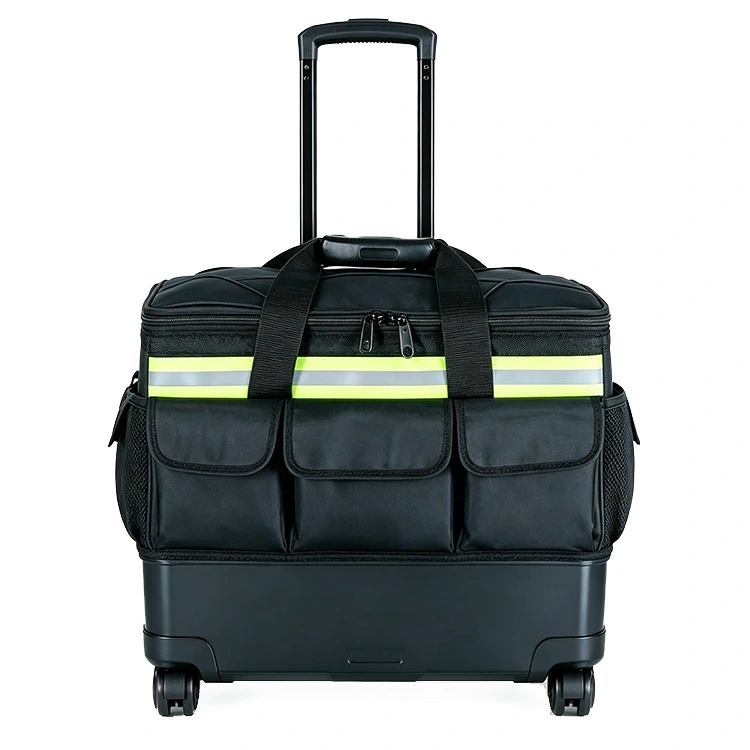
Mechanics face a constant challenge: transporting a growing collection of heavy tools across workshops, job sites, and service calls without wrecking their bodies. A Rolling Tool Bag solves this problem with wheels, rigid frames, and organized compartments, and Tianrui has spent years engineering solutions built around exactly these demands. The choice between carrying a load on your shoulders and rolling it behind you shapes daily efficiency, injury risk, and tool longevity.
The Ergonomics Argument: Load Off the Spine
Backpacks concentrate weight on the shoulders, upper back, and lumbar spine. A loaded mechanic's backpack can easily exceed 20 kg, and repeated lifting twists the torso in ways that accumulate strain. A Rolling Tool Bag transfers that load to the ground through wheels, leaving only a steering force at the handle. The table below compares the physical demands of both options.
| Factor | Backpack | Rolling Tool Bag |
|---|---|---|
| Peak spinal load | High (compressive) | Minimal |
| Shoulder fatigue over 8-hour shift | Significant | Negligible |
| Risk of repetitive strain injury | Elevated | Low |
| Suitable for long distances | Limited | High |
Capacity and Organization
Mechanics carry torque wrenches, socket sets, diagnostic scanners, and power tools. A Rolling Tool Bag from Tianrui offers multi-layer compartments, elastic loops, and hard-bottomed bays that keep heavy items low and stable. Backpacks force vertical stacking, which buries frequently used tools and encourages clutter. Rolling designs open flat, giving full visual access in seconds.
Durability on Real Job Sites
Workshop floors, gravel, and workshop thresholds destroy fabric and zippers. Tianrui builds Rolling Tool Bag models with reinforced 1680D Oxford fabric, abrasion-resistant wheel housings, and metal telescoping handles tested for thousands of cycles. A backpack's straps and seams fail under continuous heavy loads, while rolling bags isolate stress in replaceable components.
Top 3 FAQ About Rolling Tool Bags
Q: Can a Rolling Tool Bag handle rough terrain and outdoor job sites?
A: Yes, provided the wheels are large and the frame is reinforced. Tianrui Rolling Tool Bag models use oversized PU wheels and a rigid base plate that absorb shocks from gravel, curbs, and uneven concrete, keeping tools protected and the bag stable during transport.
Q: How much weight can a professional Rolling Tool Bag safely carry?
A: Most heavy-duty models are rated between 50 kg and 80 kg, but the practical limit depends on wheel quality and handle construction. Tianrui designs its Rolling Tool Bag line with load-tested telescoping handles and reinforced stitching so that full loads remain maneuverable without deformation.
Q: Is a Rolling Tool Bag practical for mechanics who travel by vehicle?
A: Absolutely. The flat, rectangular profile of a Rolling Tool Bag slides easily into van cargo areas and truck beds, and the wheels eliminate the need to lift the bag in and out repeatedly. Tianrui models include side handles for two-person lifting when the bag is fully loaded.
Key Selection Criteria
| Criterion | What to Check | Tianrui Advantage |
|---|---|---|
| Wheel quality | Diameter, material, bearings | Oversized PU wheels with sealed bearings |
| Handle strength | Telescoping cycles, wobble | Multi-stage aluminum, load-tested |
| Fabric | Denier, coating | 1680D Oxford, water-resistant |
| Organization | Compartment layout | Modular, flat-open design |
Conclusion
For mechanics, the decision comes down to protecting the body, protecting the tools, and moving faster between jobs. A Rolling Tool Bag delivers on all three, and Tianrui builds each model with the materials and testing that professional environments demand.
Contact us today to discuss bulk orders, customization options, or to request a sample of the Tianrui Rolling Tool Bag range for your workshop or distribution business.